Seaweed papers
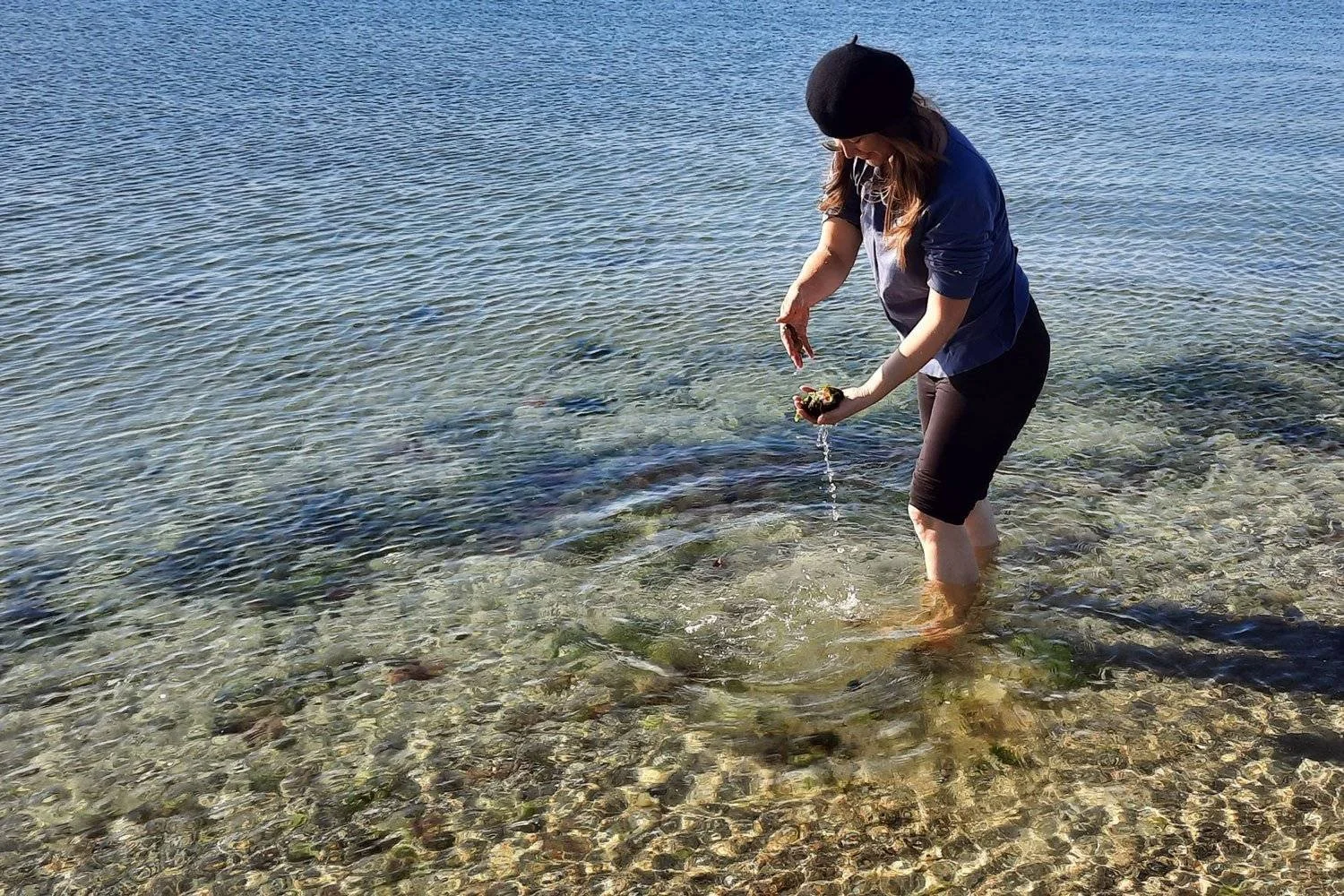
I enjoy wandering New England coastlines to respectfully collect abundant seaweed for papermaking, bioplastics, and dyes. Each artwork yields an extraordinarily detailed view of seaweed initimately embedded within fibrous pulp.
Historically, herbaria and seaweed pressings are a overlooked way Victorian era women accessed the sciences. I love both Anna Atkins’ and Emily Dickinson’s work for its tenderness, viewing nature as friend and not for domination and control.
Seaweed Papers embraces this socially disobedient history by exploring new processes to create art that does not harm nature. This work is a way to find kinship with the beauty of the living sea, all while acting as witness to changing species in our distressed oceans.


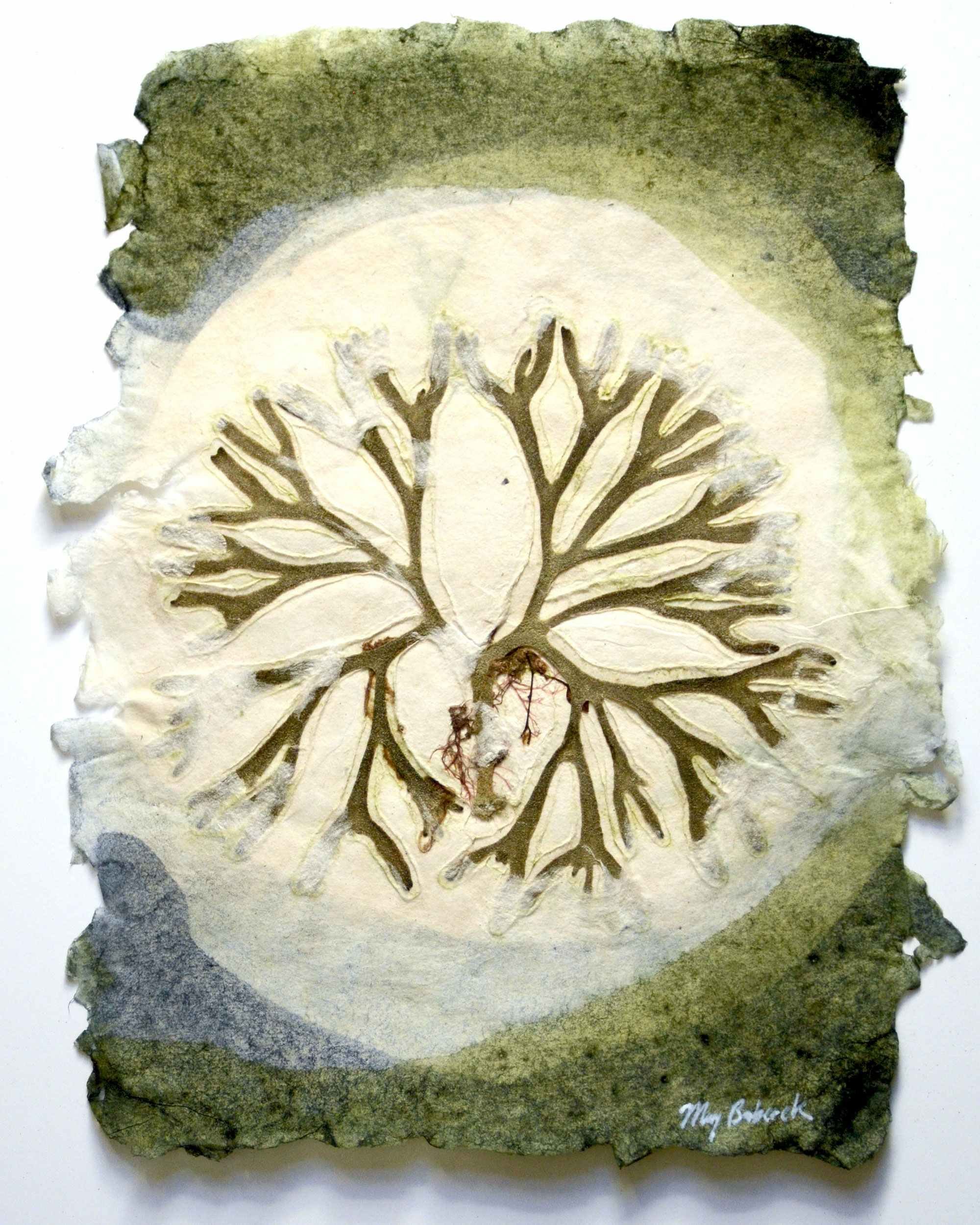
ROCKWEED
22 x 18 inches each, artist-made paper (made from Codium fragile seaweed, flax, rockweed, Szechuan banana), rockweed (Ascophyllum nodosum), bladderwrack dye, 2025
Along Rhode Island coastlines, I collected rockweed for pressing and pulping up into paper, a so-called “invasive” seaweed Codium fragile for paper pulp, and bladderwrack for natural seaweed dye.
These works also reference the decaying, pitted shells that I find.




Sea of Secret Colors
9 x 6 inches, artist-made paper (linen rag, flax, abaca), seaweeds, inks from turmeric and indigo, 2022.
After wading around Narragansett Bay and loving the experience of seeing seaweed flowing free in the salt water, I embedded the found seaweed within paper pulp. I painted handmade inks to recall the experience.


Bladderwrack Prints
9 x 6 inches, artist-made paper (linen rag, flax, abaca), seaweeds, bladderwrack eco-print, 2022.
By accident I discovered a new way to create an eco-print. Pressed seaweed next to wet handmade paper imparted its shape and color after a couple days.


Rhode Island Herbarium
12 x 17 inches, 2018 - 2021, Artist-made paper (from linen rag, artist-grown flax, abaca, cotton paper waste), seaweed, pondweed, gilded metal leaf.
I am inspired by the beauty found in aquatic plant and macroalgae species, some living in the waters for a long time, and some originating from other waters and oceans across the earth—having traveled via various natural and human transportation methods.
Organically I observe the changing lifecycles, seasons, and locations, and also research seaweed’s ecological roles and human uses in the past and present. I am continually surprised by what I find washed up through different times of the year. Along Rhode Island’s shores, I do find masses of seaweed blooms and ecologically troublesome species—results of human activity causing an imbalanced ecosystem.
Rhode Island Herbarium reflects upon this relationship between humans and nature at specific sites. The hand lettering in gilded metal leaf indicates a mix of the colloquial and researched Indigenous names of the collection sites to express the complexities and diverse histories in our landscapes. Many Algonquian place names are found throughout Rhode Island, where the First Peoples have persevered through centuries of colonization. Place names reflect this history. Oftentimes, the Indigenous name has changed to Europeon names, or have kept some of their variations. In this way, Rhode Island Herbarium becomes an emanation of each site’s spirit, sorrows, joys, histories, ecologies, and meanings.


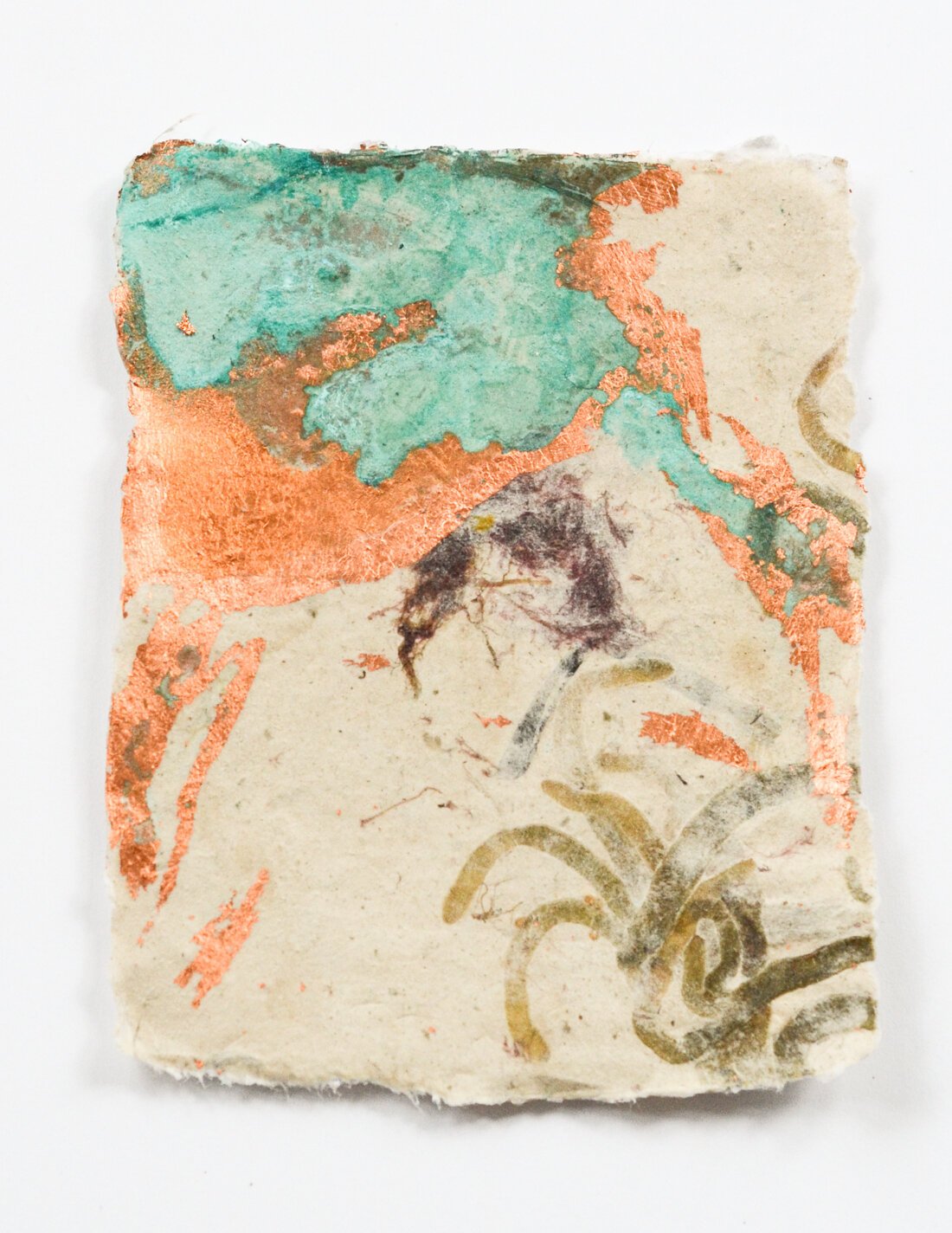
Weathering
Artist-made paper, seaweeds, copper leaf, Providence River water and Miracle Gro patina, 4 x 6 in., 2019-2020
Some waterways remain questionable to touch. On cut-down pieces of seaweed paper, I gilded copper metal leaf. With jars of collected Providence River water mixed with nitrogen-rich Miracle-Gro, the copper alchemized into blue and green patina colors. The drawings are inspired by historical waterway maps, including Great Salt Cove, a lost tidal marsh located in present-day downtown Providence, Rhode Island.


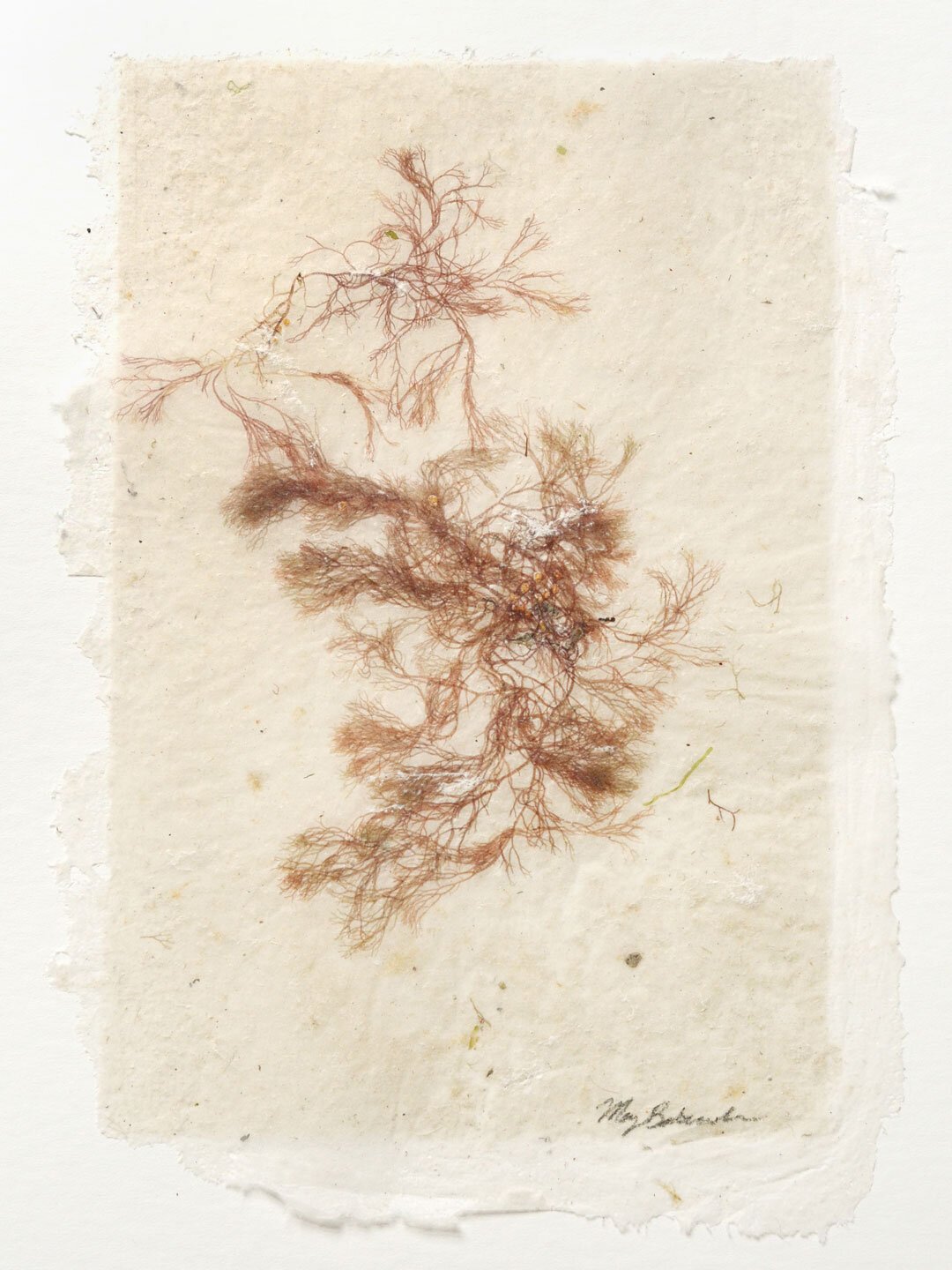


Macroalgae
9 x 6 inches, artist-made paper (linen rag, flax, abaca), seaweeds.
The first of the Seaweed Papers series, Macroalgae was an innovative identification method while researching aquatic plant and algae species for paper fiber in Rhode Island waterways.


Exhibited at:
Roger Tory Peterson Institute; T.F. Green Airport, Providence, RI; Society of Arts and Crafts, Boston, MA; Chandler Gallery, Montpelier, VT; Worlds Fair Gallery, Providence RI; Hamilton Gallery, Salve Regina University, Newport RI; City Hall Gallery, Providence, RI; Private Collections.
Resources
Learn more about the First Peoples of Rhode Island by exploring:
the First Peoples of Rhode Island Rhode Tour Curated by Katharine Kirakosian, PhD and Tomaquag Museum
Find information on the First Peoples of your location with Native Land Digital’s map of territories
Support and learn more from the Tomaquag Museum, which is Rhode Island’s only Indigenous museum “dedicated to sharing our culture, arts and history from a first person perspective.”
Seaweed Guides
A good beginner guide focused on commonly harvested Maine seaweeds can be found at the Maine Seaweed Council. Though Rhode Island is further south on the East Coast, I have found most of these listed species in my locale.
The Seaweed Site, a helpful and in-depth website about marine algae
For introduced aquatic species identification, browse the RI DEM resource page.
New England Water Species Identification from SECONN Skin Divers.