Cate McQuaid Reviews "Rhode Island Herbarium" on Ocean in a drop
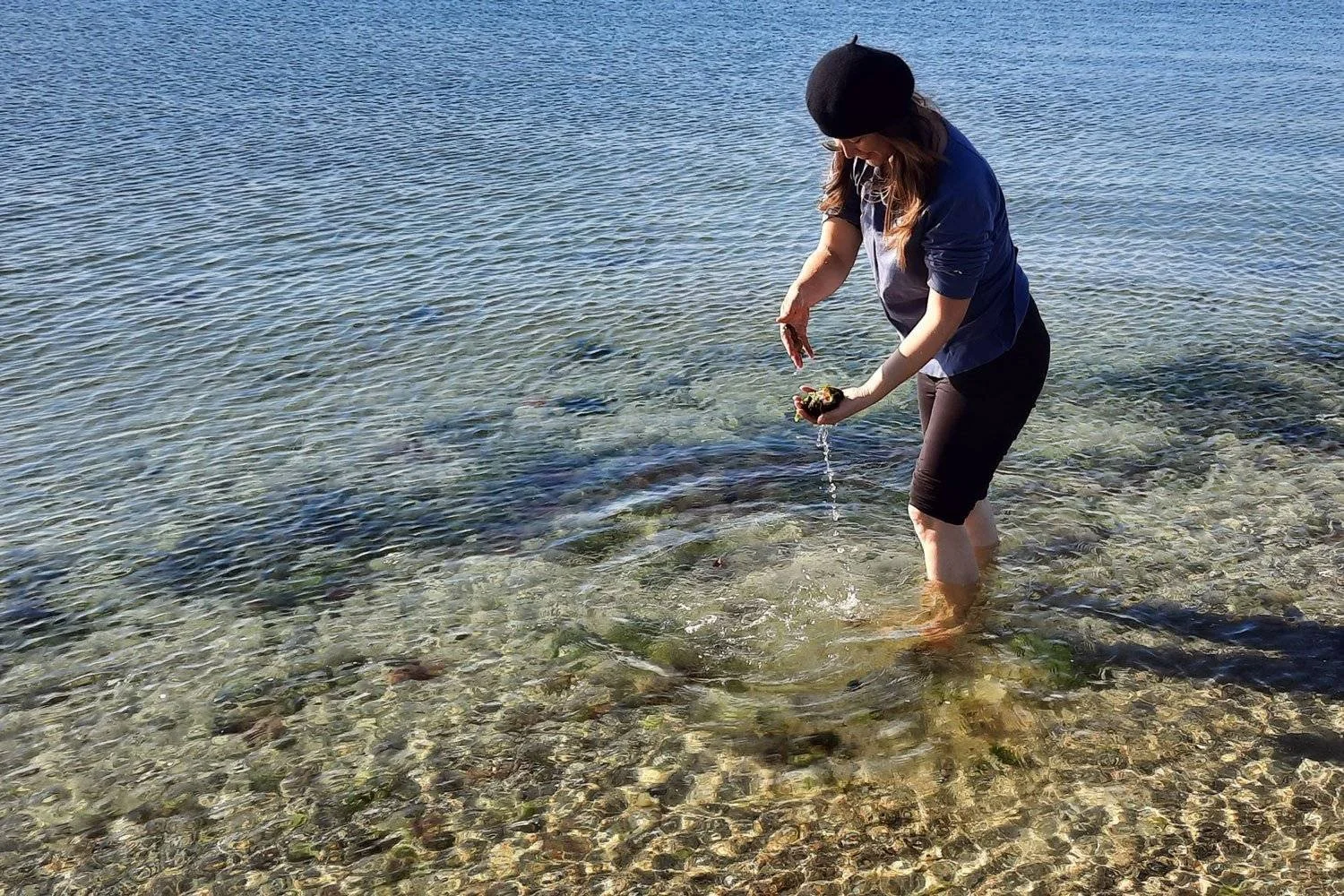
I first started looking deeply at the diversity of local seaweeds nearly 10 years ago, and my Seaweed Papers body of work is the evidence. I still collect abundant seaweed for papermaking, bioplastics, and natural dyes. In Seaweed Papers, each artwork yields an extraordinarily detailed view of seaweed intimately embedded within fibrous pulp.
Herbaria and seaweed pressings are an overlooked way Victorian era women accessed the sciences. I love both Anna Atkins’ and Emily Dickinson’s work for its tenderness, viewing nature as friend, not for domination.
Seaweed Papers embraces this socially disobedient history by exploring new processes to create art that does not harm nature. This work is a way to find kinship and belonging with the beauty of the living sea, all while acting as witness to changing species in our distressed oceans.

May Babcock, Rhode Island Herbarium: Machaquamaganset (Moonstone Beach) #1, artist-made paper (linen rag, flax, abaca), seaweed, gilded metal leaf, 17 x 12 inches.
Place Name Histories
On view at Overlap Art Space in Newport, RI right now (August 2026) are a couple of these embedded seaweed papers, part of the group exhibition Internalized Landscapes: I can feel this place in my bones curated by Alicia Renadette.
This one above ☝️ is part of the Rhode Island Herbarium series where I used metal leaf to gild the place names of where I collected the seaweed.
After much research, it was clear that many place name histories reflect how often the Indigenous place name was erased and replaced with Euro-centric names through colonization. Other place names still have variations, derivations, and summarizations of the Indigenous name. The hand-lettered place names that I chose are a mix of the colloquial and researched Indigenous names. By presenting both alongside mixtures of seaweeds, Rhode Island Herbarium becomes an emanation of each site’s sorrows, joys, histories, ecologies, and meanings.
Ocean in a Drop - An Art Review
I was touched to read one art reviewer’s response to Rhode Island Herbarium at Overlap Art Space. Cate McQuaid is a writer who has a publication called “Ocean in a drop,” where she writes about Rhode Island Herbarium more eloquently than I’m able to:
“I was walking through Internalized Landscapes musing about notions of collaboration with the land, about inhabiting a place and being inhabited by it, when one work grabbed me like a wave and dropped me on the beach of my childhood. I saw May Babcock’s Rhode Island Herbarium: Machaquamaganset (Moonstone Beach) #1, and suddenly I felt the wet sand between my toes, the cold push and tug of surf on my body, and the slurry and crawl of seaweed in my swimsuit.”
Cate goes on to describe childhood summers at Moonstone Beach, which is along the southern Rhode Island coast, and then how the seeing the work blew apart her “own little orderly approach to art reviewing”:
“The memories of inhabitants like me braid with a place’s biome and climate, history, names, and geolocation to contribute to the site’s spirit. Rhode Island Herbarium, a blossom of a piece, reads like a distillation of all those things…when May’s Moonstone Beach rang like a deep bell in my bones, all the conceptual frameworks I’d been constructing fell away. Eventually the constant flux of the river of inner and outdoor swallows them.”
Read the full review 👇 and subscribe to Ocean in a Drop for more of Cate’s insightful art writing: